


Trading and Investing in China as a Westerner
Trading and investing in China can mean buying shares on a mainland exchange, owning a Chinese business listed in Hong Kong, purchasing an overseas depositary receipt or holding a fund through a broker at home. Each route gives a different combination of companies, ownership rights and trading conditions. The first decision is therefore what exposure the investor wants. Someone looking for mainland industrial businesses may need a different route from someone interested in internationally listed internet companies. A trader following a Chinese equity index is making another choice again, because the index determines which businesses and share lines drive the price. Treating all these assets as one Chinese market can obscure the financial differences before the investment analysis has even begun.
Being a Westerner is not, by itself, an account category or a legal permission. Nationality, tax residence, physical residence and the broker’s contracting entity can each affect what is available. A British resident investing from London faces different practical questions from a US citizen living in Shanghai or a French national resident in Hong Kong. The underlying Chinese company can be the same while the permissible product, reporting obligations and payment route differ. This article focuses on publicly traded investments and the accounts used to access them. Opening a private business or negotiating a direct ownership stake requires a separate examination of foreign investment rules and the transaction itself. Access to a listed share should not be taken as evidence that the same ownership arrangement is available privately.
Mainland China and Hong Kong also need to be distinguished throughout the analysis. Shanghai and Shenzhen are mainland markets, where A-shares are quoted in renminbi and traded under mainland rules. Hong Kong has its own securities framework, exchange arrangements and market infrastructure, even when the issuer’s operations are largely on the mainland. Overseas listings add another jurisdiction for disclosure and trading, without necessarily moving the operating business or changing its exposure to Chinese policy. The listing venue therefore answers where a security trades, rather than everything about what the investor owns. A useful starting description identifies the operating business, issuer, trading venue, currency and route through which the account will hold the position. That description makes the later research and cost comparisons much more precise.
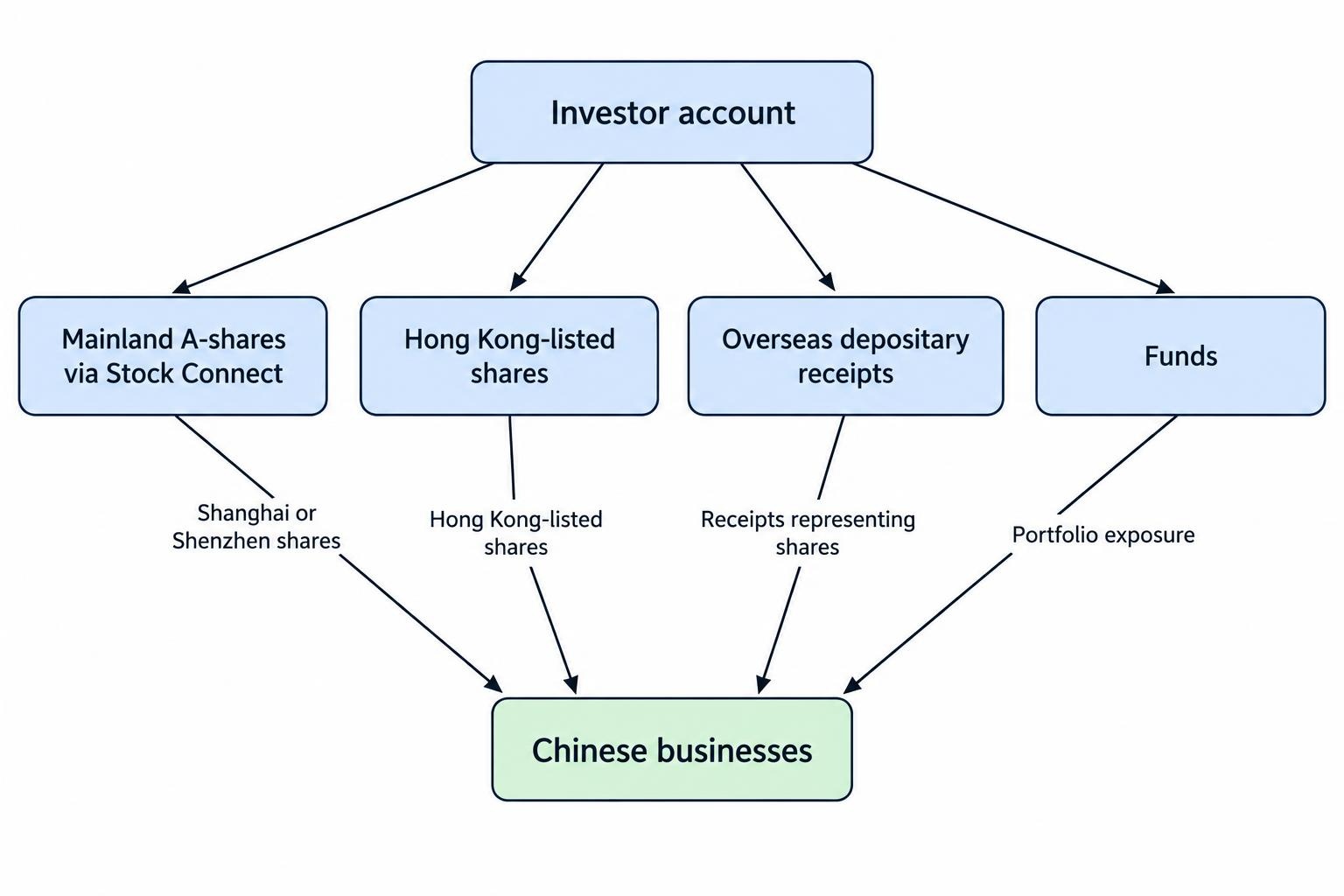
The main routes into Chinese assets
Mainland shares through Stock Connect
For an investor based outside mainland China, HKEX’s Stock Connect arrangements provide access to eligible Shanghai and Shenzhen securities through participating intermediaries. Northbound trading refers to investment into those mainland markets; Southbound trading refers to the separate route into Hong Kong. Ordinary overseas investors can access eligible securities, but the programme does not include every mainland listing or grant unrestricted access to every board. HKEX states that Northbound trading in STAR and ChiNext stocks is restricted to institutional professional investors. A retail customer should therefore confirm the exact security’s eligibility and their own account permissions before developing a strategy around it. Seeing a mainland ticker on a broker’s research screen does not establish that the customer can purchase it through their account.
A mainland A-share purchase is exposure to a particular listed company, rather than a general claim on Chinese economic growth. The company might earn most of its revenue domestically, rely heavily on exports or depend on regulated prices and public investment. Those differences matter more to its earnings than the broad label attached to the market. Stock Connect can make a security accessible without making it easy to research or suitable for the investor’s time horizon. Eligibility can also change, so establish what the broker permits if a holding becomes restricted to sales. An investor should understand the position’s exit route as well as its entry route, particularly when a strategy depends on maintaining the ability to rebalance or make repeated purchases over time.
Hong Kong listings and overseas securities
In Hong Kong, an investor can buy securities linked to mainland businesses through an account supporting the Hong Kong exchange. H-shares are shares of mainland-incorporated companies listed there, while other China-related issuers may be incorporated elsewhere. The distinction matters because a Hong Kong quotation does not imply one standard corporate structure. Some companies also have mainland A-shares, but the A and H lines should not be assumed to be freely interchangeable. Different investor groups, currencies and market conditions can produce different prices for exposure to the same issuer. A price discount is therefore a research question rather than an automatic arbitrage opportunity. Before comparing valuations, establish the rights attached to each line and whether any conversion or transfer is actually available under the applicable arrangements.
An overseas depositary receipt can provide access during the trading hours of another market. An American depositary receipt, or ADR, represents an interest in underlying shares under a depositary arrangement, and its ratio may differ from one receipt per share. An investor comparing an ADR with a Hong Kong line needs to adjust for that ratio, currencies, fees and any conversion conditions. The overseas quotation does not by itself remove Chinese operating or ownership risk. Nor should the customer assume that a second listing guarantees a seamless transfer if one venue becomes unavailable. Read the depositary agreement and ask whether the broker can process the relevant conversion. A transaction possible in principle may still involve restrictions, charges or delays that make it unsuitable for a short-term trading plan.
Funds and the importance of the underlying index
A fund can provide exposure without requiring the individual investor to select and administer each Chinese holding. However, the name China fund says little about the actual portfolio. A mainland-focused fund can differ substantially from a Hong Kong-focused product or one holding overseas-listed internet businesses. The MSCI China Index description, for example, includes several share categories and foreign listings, rather than representing only mainland A-shares. Examine the benchmark, holdings, sector weights and replication method before comparing fund performance or fees. Fund domicile and retail availability also matter to a Western investor’s access and tax position. Two products tracking similar companies can create different administrative obligations even when their marketing descriptions and recent price charts look much the same.
Fund construction can change the exposure even when two products both claim to represent large Chinese companies. A concentrated portfolio gives its largest holdings more influence over returns, while a broader portfolio can add businesses with different customers, financing needs and governance arrangements. Compare the holdings as well as the index name and establish how often they are reviewed. A hypothetical fund placing half its assets in a few internet businesses will respond differently to sector regulation from one dominated by mainland banks and manufacturers. Neither composition establishes a better investment by itself. The investor needs to decide whether the portfolio matches the intended thesis and whether its concentration is acceptable. Owning a fund reduces the need to administer each holding but leaves the economic consequences of those holdings intact.
Choosing the broker and checking custody
Access must match the security and the customer
A broker offering Hong Kong shares does not necessarily offer Northbound Stock Connect, and a provider advertising Chinese indices may offer only a derivative on an index price. Establish whether the proposed trade buys a security, a fund unit or a contract with the provider. A CFD can give price exposure without the same ownership rights as the underlying shares and may add financing and margin obligations. The investor’s residence and classification can also determine which products the broker permits. Broker research through brokerlistings.com broker comparisons can help organise the available account features, but the final check belongs in the broker’s current market permissions and customer agreement. Compare providers using the actual asset and account required, rather than the broad claim that each supports China trading.
The contracting entity determines the rules applying to the brokerage relationship, separately from the market rules governing the investment. A broker group may assign a UK customer and a mainland-resident expatriate to different companies, with different product access and complaints arrangements. Confirm the entity in the application, its regulatory record and the treatment of client assets. A licence belonging to another member of the group cannot establish the protections of the account offered. If the customer changes residence, ask whether the account can remain open and whether permissions or custody will change. The ability to log into an existing platform after a move is not sufficient evidence that the provider accepts the new residence or can continue supplying the same services.
Custody becomes particularly relevant when a holding sits within several market infrastructures. For Stock Connect securities, HKEX describes nominee services provided through HKSCC, including dividends, voting and corporate actions. The customer needs to understand how their broker passes those services through and what deadlines or charges apply. Holding through a nominee arrangement should not be confused with owning a VIE-related contractual interest, which concerns the issuer’s corporate structure rather than the account’s custody chain. Both deserve examination, but they address different relationships. Ask how rights issues, tender offers, voting instructions and transfers are handled before they become urgent. A low trading commission can be less useful if the account cannot process a corporate action important to the investment thesis.
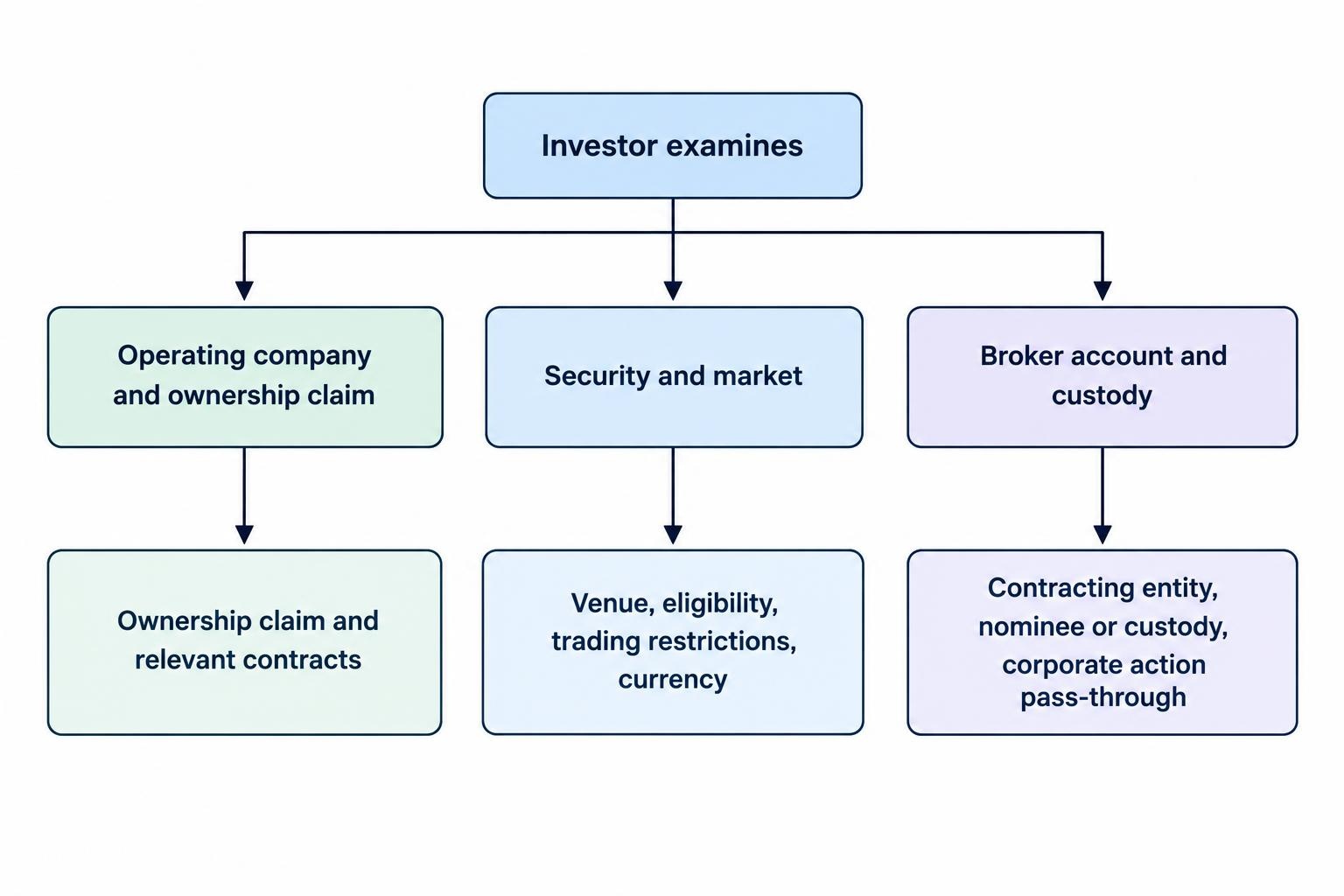
Trading mechanics across mainland Hong Kong and overseas markets
Mainland restrictions affect the exit as well as the entry
A trader accustomed to buying and selling a share during one session needs to examine the mainland rules before using the same method on A-shares. Hong Kong’s Investor and Financial Education Council explains that Shanghai and Shenzhen A-shares bought through Stock Connect can only be sold on T+1 or later. In that context, the restriction concerns resale of the newly purchased shares; it should not be confused with a simple description of when all securities and cash settle. A position opened in the morning can therefore remain exposed beyond the customer’s preferred intraday exit. A stop instruction cannot create permission to sell shares that the market rules do not yet allow the customer to sell.
Mainland price limits, suspensions and order restrictions can further affect execution. The applicable limit depends on the market segment and security, so one percentage should not be assumed for every mainland share. A security at its permitted price boundary may still lack buyers or sellers willing to execute the customer’s order. The displayed limit does not guarantee that a position can be closed at that price. HKEX publishes quotation requirements for Shanghai Connect orders, including order and lot rules. Check the equivalent requirements for the instrument being traded and the broker’s implementation. Position sizing should recognise the possibility that the intended exit is delayed or unavailable, rather than assume an ordinary stop order fixes the maximum loss under every condition.
Hong Kong and overseas trading have different schedules
Hong Kong cash equities have different trading arrangements from mainland A-shares, including the ability to conduct an ordinary purchase and resale on the same day, subject to the broker’s procedures. That does not make all Hong Kong securities equally liquid or every order immediately executable. Board lots, odd-lot handling, auctions and available market depth still matter. A Western trader using a US-listed receipt instead faces the trading hours and rules of that overseas venue. Time differences can leave a position exposed to mainland announcements while its own market is closed, followed by a gap when trading resumes. A chart of one listing may therefore reflect news at a different time from another line connected to the same business, complicating comparisons based only on the last quoted price.
The trading calendar should be checked for the access route, not just for the issuer’s country. HKEX publishes a separate Stock Connect trading calendar, which helps identify when the relevant cross-border service operates. A market holiday can also affect funding or settlement even when another exchange is open. A trader preparing through daytrading.com trading education should connect general lessons about orders and risk to the actual market’s timetable and restrictions. The useful operational test is whether the strategy can be executed with the available order types, hours and position sizes. A method developed in a continuously accessible derivative may behave differently when transferred to a mainland cash share that cannot be resold immediately after purchase.
Using another instrument to trade while the underlying market is closed introduces a further risk. An index future, an overseas ETF and an individual depositary receipt do not necessarily track the same basket or respond by the same amount. A position intended as a temporary hedge can therefore leave part of the original exposure uncovered. Contract size, financing and the time at which prices are observed can add differences that are invisible in a broad comparison of daily charts. Identify the relationship between the instruments and test how much exposure the proposed hedge creates. For a trader working across Chinese and Western sessions, the ability to place a second order is useful only if that order changes the intended risk rather than adding another poorly understood position.
Researching Chinese companies and the ownership claim
Economic growth and shareholder returns are different questions
A large economy can contain growing businesses without guaranteeing attractive returns for every listed shareholder. The investment outcome depends on the price paid, competition, capital requirements and the share of economic value that reaches outside investors. A company increasing revenue may also issue more shares, accept low returns on investment or retain cash without a clear use for it. Those possibilities are relevant in any market, but they deserve attention when an investor’s China thesis relies mainly on the country’s size or a policy ambition. Translate the economic argument into company accounts. Identify who pays the business, what supports its margins and how it can fund growth without repeatedly diluting shareholders. The investment case becomes assessable only when the expected benefits can be connected to the security being purchased.
Company research should reconcile reported earnings with operating cash flow, capital spending and the balance sheet. Examine receivables, related-party transactions, guarantees and restrictions on cash rather than assume a large cash balance is fully available for dividends or buybacks. For an offshore holding company, the location of that cash can matter as much as the total reported. Consider whether profits belong to subsidiaries that can distribute them and what legal or contractual steps separate those subsidiaries from the listed issuer. Use filings for the actual company and security, including original disclosures where possible. English-language summaries can be useful starting points, but a summary of earnings growth rarely resolves the ownership, cash-transfer or related-party questions that determine the quality of the shareholder’s claim.
Variable interest entities and offshore holding companies
Some China-related listings use a variable interest entity, or VIE, structure. In these arrangements, the listed holding company may obtain economic exposure to a mainland operating business through contracts rather than equity ownership of that business. The SEC’s disclosure guidance for China-based companies highlights the need to explain the entities involved, contractual arrangements and risks to investors. The term VIE should not be used as a synonym for every Chinese share or every ADR. Inspect the issuer’s structure to establish what applies. Where contracts provide the connection, enforceability and the ability to transfer economic benefits become part of the valuation. Familiar branding or a US quotation cannot replace examination of the legal claim represented by the listed security.
Governance research then needs to consider who can influence the business and how their interests relate to minority shareholders. State ownership can support access to capital or strategically important projects while also creating objectives beyond maximising the listed company’s return. Founder control, concentrated voting rights and transactions within a corporate group can create different conflicts. These features should be assessed from the documents and conduct of the individual issuer, rather than treated as proof that every Chinese company behaves alike. Review dividend policy, buybacks, dilution and major acquisitions over time. The question is whether management’s capital allocation supports the expected return on the price being paid. A low valuation multiple may be attractive, but it may also reflect risks to the persistence or distribution of earnings.
Chinese policy and international relations can affect those earnings as well as the valuation applied to them. Sector regulation, procurement rules, export controls and access to foreign customers or technology can change a business’s prospects. An investor should distinguish an announced proposal from an enacted measure and identify the authority and activity involved. A policy supporting an industry does not guarantee profits for every firm in it, particularly if support encourages additional capacity and stronger price competition. Build scenarios around revenue, margins and financing instead of treating a favourable policy headline as a complete thesis. For traders, the same distinction helps separate a temporary reaction from a change that could alter the business’s cash generation over several years.
A simple valuation example shows why the earnings assumption deserves as much attention as the multiple. At a hypothetical share price of 40 and annual earnings per share of 4, the price-to-earnings ratio is ten. If sustainable earnings are actually 2 after a temporary benefit disappears, the ratio on that revised estimate is twenty. The apparent discount has changed without the share price moving. For a Chinese exporter, assess the effect of exchange rates, tariffs and customer concentration; for a domestic lender, examine asset quality and the basis of reported earnings. Comparisons should use businesses with reasonably comparable accounts and risks. The objective is to identify a price supported by plausible shareholder returns, rather than assume that a lower headline multiple than a Western peer establishes undervaluation.
Currency exposure and the full investment cost
Trading currency does not define the whole currency risk
Mainland A-shares are quoted in renminbi, Hong Kong securities often trade in Hong Kong dollars and US receipts commonly trade in US dollars. Those quotation currencies do not fully describe the business’s economic exposure. A Hong Kong-listed manufacturer may earn export revenue in dollars and incur costs in renminbi, while another issuer relies on mainland domestic spending. An ETF’s dollar quotation also does not automatically remove currency movements from its underlying holdings. Examine whether a fund hedges currency exposure and which exposure the hedge is designed to address. Renminbi is traded through onshore and offshore arrangements, commonly labelled CNY and CNH, whose prices and funding conditions can differ. The broker’s conversion route should therefore be identified rather than assumed from the three-letter label displayed on a statement.
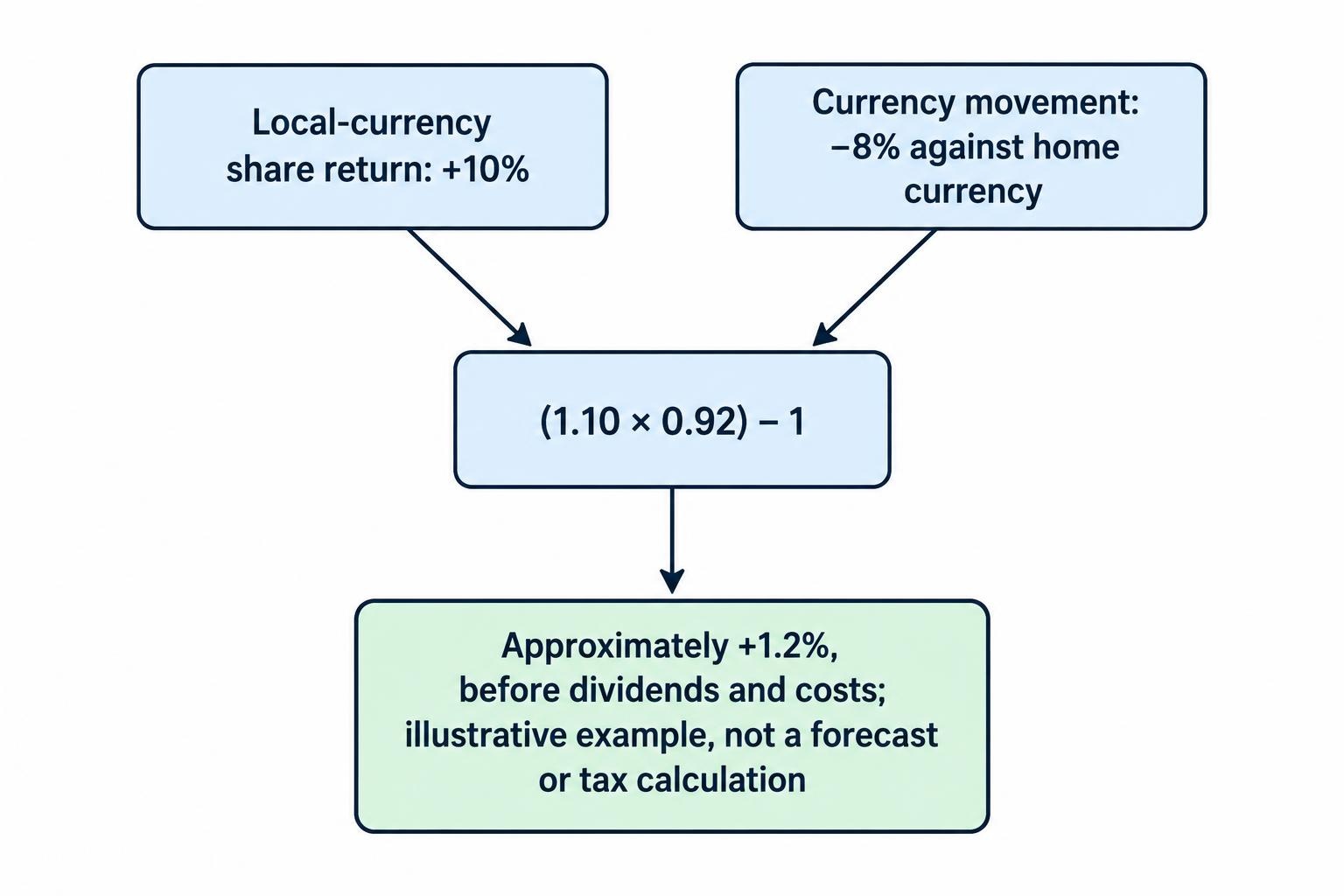
The home-currency return combines the investment result with the exchange-rate movement. In a simplified example, a share price rises 10% in its local currency while that currency falls 8% against the investor’s home currency. The combined result is approximately 1.2% before dividends and costs, calculated as 1.10 multiplied by 0.92, less one. Adding and subtracting the two percentages would not give the same answer. This is a performance illustration rather than a prediction or tax calculation. It shows why a Western investor should retain both the security’s local-currency return and the return available after conversion. A successful company thesis can be partly offset by currency depreciation, while a currency gain can temporarily conceal weak investment performance.
Transaction costs also vary by route. Brokerage, bid-ask spreads, exchange charges, applicable duties, currency conversion and custody charges can all contribute, while funds add ongoing expenses and possible tracking differences. Depositary receipts can introduce fees under their own arrangements. Calculate the expected cost for the intended position size and holding period, using the current schedule rather than a minimum advertised commission. Repeated short-term transactions magnify the importance of costs paid on both purchase and sale, whereas a long-term fund holding makes recurring expenses more relevant. A derivative adds another layer through financing and margin requirements. Compare the total financial arrangement, because a product with a smaller entry cost can produce a larger continuing cost or a materially different ownership position.
Home country restrictions and taxation
United States investors and US persons
For US persons, permission to buy a security should be checked against the applicable US restrictions as well as the foreign market’s access rules. OFAC’s Chinese Military Companies sanctions guidance addresses restrictions involving designated securities and relevant exposures. This is a US framework, not a general prohibition applying identically to every Western investor or every Chinese company. A company appearing in a news report about one government list should not automatically be treated as subject to every other list’s consequences. Check the current programme, designation and transaction involved, including any relevant fund or derivative exposure. A broker may impose additional restrictions of its own, so the ability to find a ticker or obtain a quote does not establish that a proposed purchase is permitted.
The US outbound investment programme is another framework that needs separate treatment. Treasury’s outbound investment guidance addresses covered transactions and exceptions, including qualifying publicly traded securities. It should not be described as a blanket ban on ordinary US investment in Chinese listed shares. Nor does an exception under that programme override a separate sanctions restriction. The distinction becomes especially important when moving from a conventional minority purchase of a listed security to a private investment, special contractual rights or a fund arrangement. US persons should assess the actual transaction under the current rules before committing capital. Treating all measures as a single China investment ban can both exaggerate restrictions on one route and overlook requirements affecting another.
US tax considerations can also change the choice of fund. A US person considering a non-US fund should examine possible passive foreign investment company treatment and related reporting, rather than assume an overseas ETF is administratively equivalent to a US fund. The IRS’s explanation of Form 8621 identifies filing circumstances for shareholders of a PFIC. Whether a particular investment falls within those rules depends on its classification and the taxpayer’s circumstances. This is a US tax question and should not be transferred automatically to a British, Canadian or European investor. Obtain product-specific advice before choosing a structure whose reporting burden may outweigh a small difference in annual fund fees. The domicile and legal form of the fund can matter independently of where its shares trade.
United Kingdom and other home jurisdictions
For UK residents and investors elsewhere in Europe or other Western jurisdictions, use the rules applying to the actual residence, account and product. Retail fund access, account wrappers and reporting requirements differ, so US product availability is not a universal guide. A UK reader using investing.co.uk investment guides can separate the decision about China exposure from the choice of account and fund structure used to obtain it. Dividends, capital gains and foreign withholding also require separate examination; buying through Hong Kong does not establish that all resulting income is tax free. Keep distribution records and transaction-currency information for home-country reporting and any available relief. Tax treatment on the Chinese or Hong Kong side and tax due at home are related questions that should not be collapsed into one assumed rate.
Investing while living in mainland China
Local eligibility and an existing overseas account
A foreign national living in mainland China faces an additional account-access question. A passport alone should not be assumed to provide unrestricted access to a domestic A-share account. Shanghai’s official guidance on foreign individuals opening A-share accounts identifies qualifying categories, including foreign permanent residents and foreign individuals working in China, and describes employment documentation. The precise requirements should be confirmed with a local securities firm for the applicant’s status and current rules. This is a mainland account route, separate from an offshore resident purchasing eligible shares through Stock Connect. Being physically present in China does not automatically make the two routes interchangeable or establish that every product available to a local national is available to the foreign applicant.
An existing overseas account creates another set of practical questions after relocation. Tell the broker about the change of residence and confirm whether it can continue to provide the account, accept funding and maintain the same product permissions. A foreign account opened while living elsewhere may be subject to different terms once the customer becomes mainland resident. Digital access is only one part of this: a platform loading successfully does not establish that the broker accepts the customer’s updated status. Keep tax-residence records, account agreements and identification current. If the account must move to another entity or some products become restricted, establish the effect on custody, transfers and open positions before the change is completed. Relocation can alter an investment arrangement without changing the investor’s nationality.
Moving money and preserving documentation
Money earned in mainland China also needs an appropriate banking route when converted or transferred abroad. Official Shanghai guidance on remitting employment income describes documentation such as employment, income and tax evidence. Shanghai also operates qualifying facilitation arrangements, so the actual process should be confirmed with the bank rather than inferred from another expatriate’s experience. Permission to remit documented salary should not be treated as unrestricted permission for every capital transaction or as proof that an overseas brokerage can accept the transfer. Preserve the records connecting income, tax payment, conversion and receipt. Tax residence in China and continuing obligations elsewhere also need assessment. A payment that succeeds operationally does not settle the separate tax or investment-access questions.
Deciding the role of China in the portfolio
The investment decision should identify what China exposure adds to the existing portfolio. A global or emerging-market fund may already hold Chinese companies, while a technology fund may contain some of the same offshore issuers as a dedicated China product. Adding another fund can therefore increase concentration in familiar holdings instead of broadening the portfolio as expected. Examine company and sector overlap and distinguish mainland domestic exposure from offshore-listed businesses. A stated allocation to China is more informative when the investor can explain which earnings, policy and currency risks it contains. The intended position should also be assessed against employment and other assets: someone earning income from a China-related business may already have meaningful exposure before purchasing any listed securities.
For an individual company, the thesis needs an expected source of return and evidence that would challenge it. That might involve cash generation, a change in capital allocation or a valuation that compensates for specified risks. For a fund, examine whether its benchmark provides the intended exposure and whether the chosen structure is accessible and manageable under the investor’s home rules. For a trader, establish whether the order types, resale restrictions and market hours permit the planned entry and exit. These decisions share a need for precision but use different time horizons. A long-term view on Chinese consumption does not establish that a short-term price position is well timed, and a successful trade does not establish that the issuer is suitable for a permanent allocation.
Position size should recognise both ordinary market losses and disruptions to access, liquidity or the investment structure. Avoid depending on a rapid exit where the venue or route can prevent one, and retain enough information to manage the holding through corporate actions or changes in broker permissions. Review the position when the business, valuation or applicable rules change, rather than only when a broad political headline attracts attention. Trading and investing in China is most manageable when the Western investor can connect the operating company to the security, the security to the access route and the resulting return to their home currency and obligations. That makes the decision about a defined financial claim whose potential return and risk