Passive and actively managed China funds offer two different ways to own Chinese equities: follow a defined index, or give a manager discretion over the portfolio. Neither approach removes the risks of investing in China. The choice changes who selects the holdings, how much discretion they have, and what you pay for that work.
The useful question is not whether active or passive investing wins in principle. It is whether a fund delivers the Chinese market exposure you want at a reasonable cost, with risks you can assess. Within the broader range of China ETFs and investment funds, investment scope often matters more than the management label.
What Separates Passive and Active China Funds?
A passive China fund seeks to track an index. Its holdings and weights follow the benchmark’s rules, subject to the fund’s replication method and operating constraints. The manager still handles trading, cash flows and corporate actions, but does not normally replace an index constituent because its valuation looks unattractive.
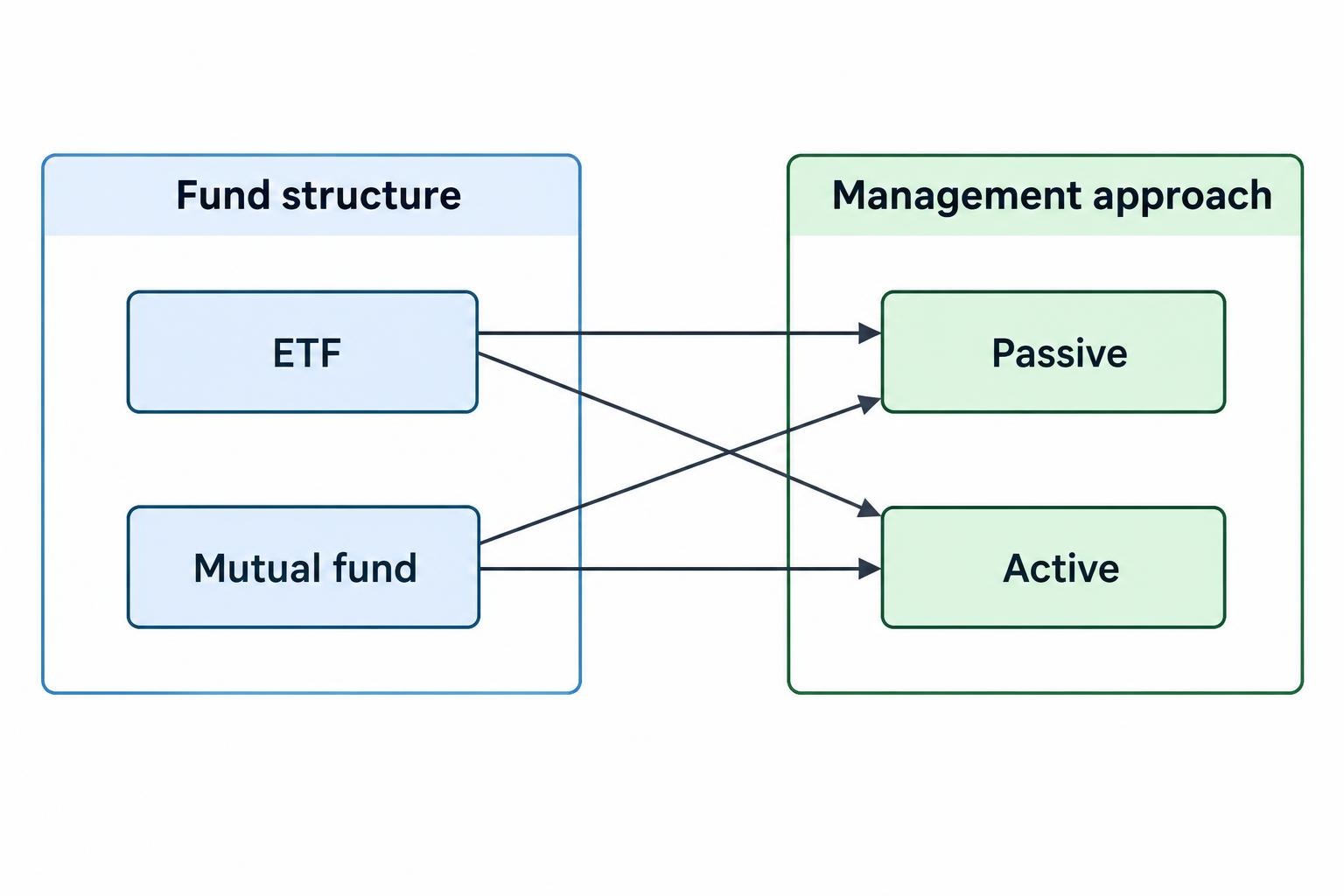
An active China fund gives its manager discretion to select investments within the stated mandate. That might mean favoring profitable manufacturers, avoiding highly indebted businesses, or shifting between mainland and offshore listings. An active fund can be a mutual fund or an ETF: the SEC’s definition of an actively managed fund covers both structures.
“ETF” describes a fund structure, not a promise of passive management. Likewise, an index strategy does not automatically provide broad exposure. A passive fund tracking one Chinese industry can be much narrower than an active portfolio spread across several sectors.
| Comparison | Passive China fund | Active China fund |
|---|---|---|
| Portfolio selection | Follows benchmark rules | Reflects manager decisions within its mandate |
| Main assessment | Suitable index and effective tracking | Repeatable process and results after costs |
| Investment discretion | Constrained by index membership and weights | Depends on prospectus permissions |
| Distinctive risk | Unwanted benchmark exposure | Unsuccessful decisions or changes in management |
Compare the Investment Universe Before the Management Style
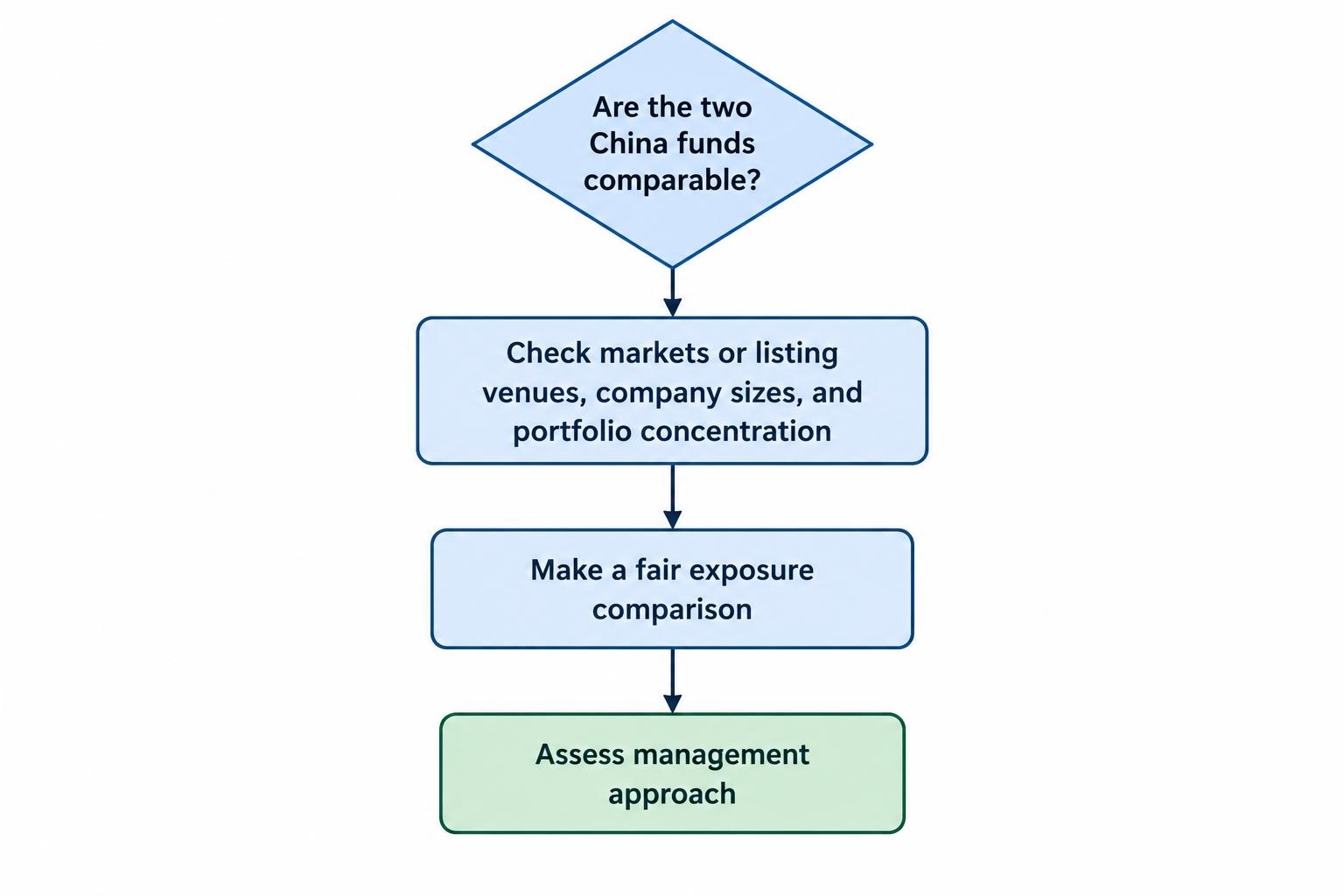
Two funds carrying “China” in their names may own substantially different portfolios. One may focus on mainland A-shares, another on Chinese companies listed offshore, and another on both. A Greater China mandate may extend beyond mainland Chinese companies. Read the investment policy rather than treating the name as a holdings list.
The MSCI China Index methodology and composition illustrate why benchmark details matter. The index includes large and medium-sized companies across several Chinese share classes and foreign listings. Its methodology represents eligible large and mid-cap A-shares at 20% of their free float adjusted market capitalization. That is an inclusion factor, not a statement that A-shares make up 20% of the index.
This affects an active versus passive comparison. An active manager with substantial mainland exposure might beat an offshore-heavy benchmark because mainland shares performed better. That result does not, by itself, establish superior stock selection.
Start with three questions: which markets can the fund own, which company sizes can it hold, and how concentrated can it become? Our comparison of CSI 300 and MSCI China exposure examines the benchmark choice separately. Here, the task is to establish a fair comparison before judging either management approach.
The Case for Passive China Funds
Passive management offers a straightforward proposition: accept the chosen market exposure rather than pay someone to depart from it. For investors who want an allocation to a defined Chinese equity universe, that can make portfolio oversight simpler.
The investment process is also easier to describe. You can examine index eligibility, weighting rules, constituent reviews and concentration limits. You do not need a forecast of which portfolio manager will make the best decisions over the next several years.
Index strategies can reduce research and management costs, but low fees are not automatic. They can also lag their benchmark through expenses, trading costs and imperfect replication. These trade-offs are covered in the SEC’s guidance on index fund costs and tracking risks.
The main constraint is deliberate: the portfolio follows the index. If an eligible business has weak governance or an expensive valuation, the fund generally cannot exclude it simply on that judgment. Passive investing removes discretionary stock selection, not the need to inspect what the portfolio owns.
The Case for Active China Funds
The strongest argument for active management is discretion with a clear purpose. A manager might impose stricter balance sheet standards, cap exposure to individual companies, or refuse investments whose ownership structures conflict with the strategy. Whether that freedom produces better outcomes is a separate question.
Consider a hypothetical fund focused on companies with durable cash generation. Its manager could reject a fast-growing business if receivables rise much faster than sales, or avoid an apparently cheap company whose debt needs refinancing soon. An index fund would normally act on benchmark rules rather than that financial judgment.
But an active manager can be wrong. Avoiding a troubled company helps only if the assessment is sound and the replacement investment offers a better outcome. A cautious portfolio can also lag sharply when speculative shares rally.
Judge the process against the mandate. An active fund designed to reduce concentration deserves a different assessment from one seeking aggressive growth. Neither should receive credit simply for holding fewer stocks or publishing lengthy research. Research is an input; the portfolio is what investors actually own.
How Much Extra Performance Must an Active Fund Deliver?
Compare the exact share classes available through your account. A fund may offer several classes with different charges, minimum investments and distribution arrangements. A favorable fee quoted for an institutional class is not useful if you cannot buy it.
Suppose, purely for illustration, a passive fund charges 0.30% annually and an active alternative charges 1.20%. The difference is 0.90 percentage points. On a constant $20,000 balance, that represents $180 a year before other costs.
Using a simplified subtraction, if both portfolios earn 7% before those charges, their returns would be about 6.70% and 5.80%. The active portfolio needs roughly 0.90 percentage points of extra gross performance just to offset the stated fee difference. Real expenses accrue through the year, so actual results will not follow this shortcut exactly.
Do not stop at the management fee. Review total operating expenses, temporary fee waivers, platform charges and transaction costs. For a passive fund, realized tracking difference helps show how implementation affected returns. Our guide to China ETF fees, liquidity and tracking differences covers those comparisons in more detail.
Published fund returns generally already reflect operating expenses. Check the reporting basis before adjusting them; subtracting the expense ratio again can count the same charge twice.
What Does the Performance Evidence Show?
Evidence does not support a blanket claim that active China funds always win or always lose. For periods ending December 31, 2025, 43.3% of China-domiciled large-cap funds underperformed the S&P China A 300 over one year, compared with 65.6% over three years and 52.8% over five years. These figures appear in the SPIVA Asia Ex-Japan Year-End 2025 scorecard, which also accounts for funds that closed or merged.
The scope matters. This category concerns China-domiciled large-cap funds measured against an A-share benchmark. It does not establish the success rate of offshore China mutual funds, every active China ETF, or managers using broader mandates.
The practical lesson is narrower: the assessment changes with the period, fund category and benchmark. A strong year can demonstrate that active managers had opportunities without identifying which managers will succeed next.
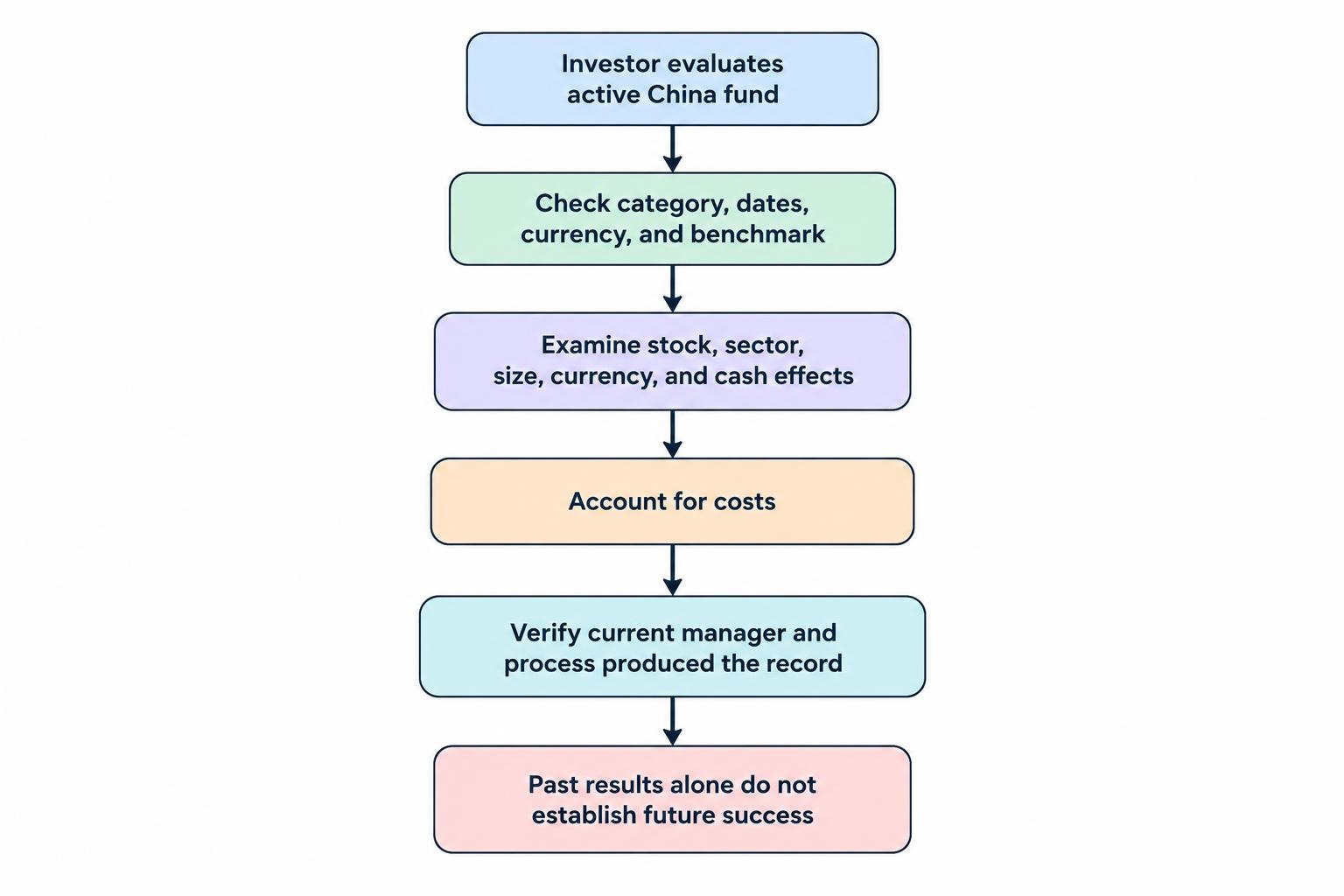
Use performance studies to challenge assumptions, not replace fund research. Before selecting a past winner, ask whether the current manager, process and investment permissions match those responsible for the record.
How to Assess an Active Manager
Separate stock selection from other bets
Request or review performance attribution where available. Did the fund outperform through individual holdings, sector allocations, company size, currency exposure or cash? A growth-focused portfolio beating a broad index during a growth rally is different from consistent gains across several sources.
Compare results in the same currency, over matching dates, with dividends treated consistently. Then examine rolling periods rather than relying on one favorable start date. A five-year annualized figure can conceal very different experiences along the way.
Check whether the portfolio matches the explanation
A manager describing a valuation-led strategy should be able to explain how holdings meet that discipline. Persistent departures deserve scrutiny. So does a portfolio that closely resembles its benchmark while charging much more for discretionary management.
Differences from an index are not proof of skill, though. A concentrated portfolio can be very different and very wrong. Look for decisions that follow a coherent process, not difference for its own sake.
Review people, capacity and incentives
Check manager tenure, team changes and responsibility for research. If the current team joined recently, the full fund history should not be treated as its record. For strategies investing in smaller companies, ask how portfolio growth affects trading and position sizes.
Also inspect performance fee terms where applicable. The relevant questions include which benchmark is used, when fees accrue, and whether earlier losses must be recovered before another performance fee becomes payable.
Fund Structure and Trading Still Matter
After comparing strategies, inspect how you will buy and hold the fund. For an ETF, review its bid–ask spread and trading price relative to net asset value. A low annual charge does not make an unfavorable purchase price disappear.
For US ETFs relying on Rule 6c-11, required disclosures include prior-day net asset value, market price, premium or discount, and the median bid–ask spread over the previous 30 calendar days. The SEC’s ETF disclosure guidance identifies these measures. They provide practical checks beyond the fund’s headline fee.
Confirm domicile, account eligibility, distribution policy and tax treatment before buying. These questions apply to both management styles. For US taxpayers, an overseas listing is a reason to investigate reporting requirements, not assume the fund works like a US-listed equivalent.
Neither approach is a substitute for assessing country risk. An active manager’s discretion and a passive fund’s diversification do not guarantee protection from market declines. Assess both within your wider plan for managing investment risks in China.
Can You Combine Passive and Active China Funds?
A combined approach can assign different jobs to each fund. A passive holding might provide exposure to a broad benchmark, while a smaller active allocation pursues a clearly defined departure, such as different company sizes or stricter financial criteria.
Check holdings overlap before calling the combination diversified. Two funds owning many of the same large companies may add fees without changing exposure very much. Assess their combined company, sector and market weights rather than examining each in isolation.
Set a review process before investing. For an active allocation, review mandate changes, personnel departures, costs and performance explanations. Avoid replacing a manager solely because of a weak quarter, but do not let patience become an excuse to ignore a broken process.
Which Approach Fits Your Objective?
A low-cost passive fund is a sensible comparison point when your goal is exposure to a defined Chinese equity market. Its case rests on a suitable benchmark, acceptable concentration and effective implementation.
An active fund needs an extra justification: a disciplined process that makes useful departures from that benchmark, with charges you consider reasonable. The justification should survive more than a recent performance chart.
Choose the exposure first, compare costs second, and assess the management approach against the job you need done. Neither label makes a fund suitable on its own.