The People’s Bank of China’s daily fixing gives renminbi markets a reference point, a trading boundary and a policy signal. It does not dictate every transaction price. Its influence comes from how the announced rate compares with market expectations, where onshore trading sits relative to it, and how offshore investors respond.
For businesses paying Chinese suppliers and investors holding renminbi assets, that distinction matters. A fixing that supports the currency can coexist with a weaker market exchange rate. Reading the announcement without checking the market reaction can produce the wrong answer, even when the headline sounds straightforward.
This guide focuses on the fixing mechanism and its practical interpretation. The broader differences between the two renminbi markets are covered in our guide to onshore CNY and offshore CNH.
What Is the PBOC’s Daily Fixing?
The daily fixing, formally called the central parity rate, is an official exchange rate reference. The China Foreign Exchange Trade System, or CFETS, publishes it under PBOC authorization. For the dollar pair, the rate states how many renminbi equal one US dollar.
The framework provides for publication at 9:15 a.m. Beijing time on each working day. Onshore interbank USD/CNY spot trading may take place within 2% above or below that day’s central parity. These arrangements appear in the PBOC circular governing interbank exchange rates and daily central parity publication.
Three prices therefore need to stay separate: the fixing, the onshore market rate and the offshore market rate. The fixing anchors the onshore dollar trading band. The market rates show where buyers and sellers actually transact.
Quotation direction can cause confusion. If USD/CNY rises from 7.1000 to 7.1500, one dollar buys more renminbi, so the renminbi has weakened. A lower USD/CNY fixing means a stronger renminbi reference rate. “Higher fixing” is not the same thing as “stronger yuan.”
How the Fixing Sets the Onshore Trading Band
The daily band is calculated around the fixing, not around the previous day’s closing market price. That makes the midpoint operationally important even when the market trades some distance away from it.
Suppose, purely for illustration, that the fixing is 7.1000 renminbi per dollar. The boundaries would be:
| Reference point | Calculation | USD/CNY rate |
|---|---|---|
| Stronger renminbi boundary | 7.1000 × 0.98 | 6.9580 |
| Daily central parity | Announced midpoint | 7.1000 |
| Weaker renminbi boundary | 7.1000 × 1.02 | 7.2420 |
If onshore USD/CNY trades at 7.2300 in this example, it is close to the weaker renminbi boundary. That would suggest substantial dollar demand relative to the official midpoint. It would not mean the fixing itself was 7.2300.
The band also resets when a new fixing is announced. It is not a permanent floor or ceiling, and it does not guarantee that a position cannot lose more than 2% over several days. A sequence of changed midpoints can move the permitted trading range.
Nor should a business treat the midpoint as an executable bank quote. Payment timing, the bank’s spread, transaction size and settlement arrangements can all affect the conversion price. The fixing is a benchmark, not a standing offer to exchange money.
How CFETS Calculates the Central Parity
The fixing is not simply yesterday’s closing rate carried forward. CFETS requests quotations from market makers before the market opens. Those quotations should consider the previous day’s interbank closing rate, foreign exchange supply and demand, and movements in major currencies. CFETS removes the highest and lowest quotations, then calculates a weighted average of the remainder. Its central parity formation mechanism describes this process.
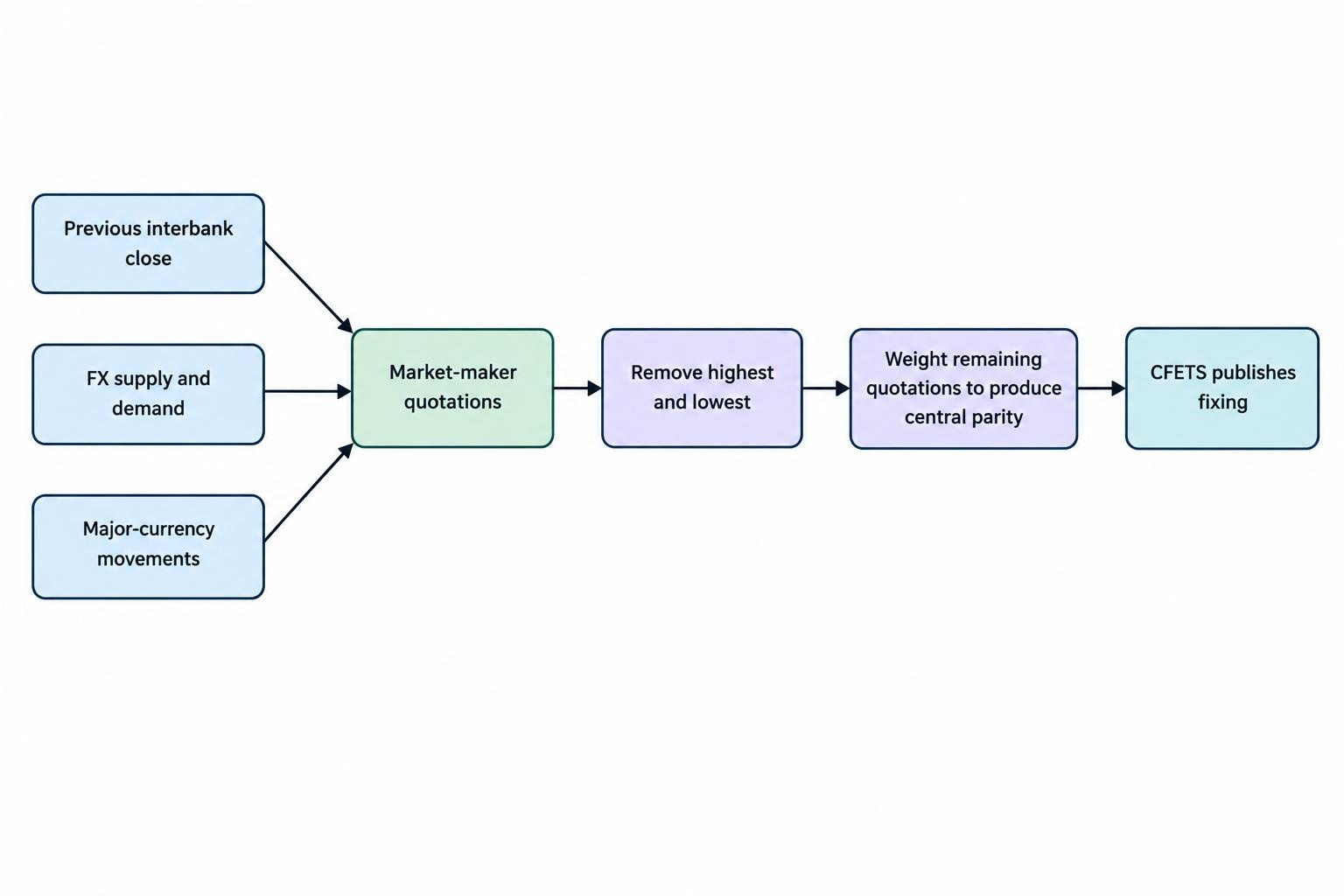
The previous close provides a market reference. Movements in other currencies help account for changes in the dollar and the renminbi’s relative value. Supply and demand provide another input. Together, these explain why the next fixing need not match the last onshore transaction.
The weighting process also means the fixing is not a simple average that an outside observer can reproduce from a handful of public exchange rates. An analyst can estimate an expected fixing, but that estimate remains a model output rather than an official calculation.
Where Countercyclical Adjustments Fit
The mechanism has changed over time. A countercyclical factor was introduced in 2017 to lean against self reinforcing, one directional market behavior. The economic concern is straightforward: if depreciation encourages more dollar buying, and that buying weakens the closing rate, mechanically carrying the move into the next fixing could reinforce the cycle.
BIS research on renminbi fixing regimes examines the transition, basket management and countercyclical management phases following the August 2015 reform. The historical changes are a reason not to assume that one forecasting formula will remain reliable indefinitely.
For practical analysis, separate the published quotation procedure from an estimate of the policy adjustment embedded in a particular fixing. A gap between an analyst’s estimate and the announced rate may contain policy information. It does not reveal every internal input or establish an exact calculation for the following day.
Why the Surprise Matters More Than the Daily Change
A fixing can weaken compared with yesterday and still signal support for the renminbi. The relevant comparison is not only the previous fixing. It is also the rate the market expected after accounting for intervening currency moves.
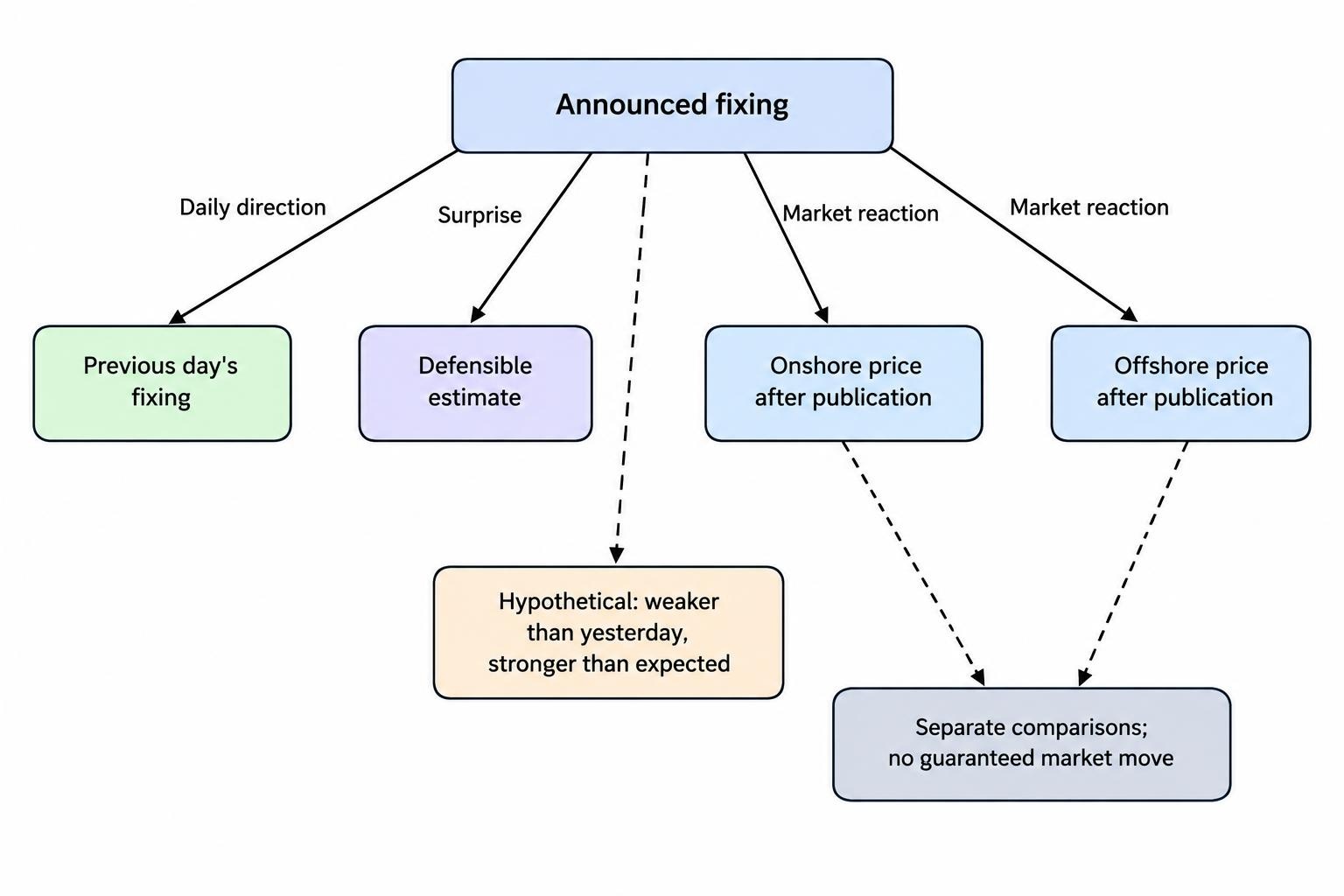
Consider this hypothetical sequence. Yesterday’s fixing was 7.0800. After overnight dollar strength, an analyst estimates today’s fixing at 7.1400. The announced rate is 7.1000.
The new midpoint is weaker for the renminbi than yesterday’s 7.0800. Yet it is stronger than the analyst’s expected 7.1400. One interpretation is that the fixing accommodates some depreciation while leaning against the full move implied by that model.
Both descriptions can be correct: the renminbi reference rate weakened day to day, and the fixing was stronger than expected. Headlines that report only one comparison can leave out the more useful part.
Analysts should also avoid false precision. Different forecasting models can use different currency baskets, observation times and adjustment assumptions. Before treating a fixing surprise as meaningful, establish how the expected rate was calculated. A large model error is not automatically a large policy intervention.
Read a Sequence, Not Just One Announcement
A single surprise offers less evidence than a repeated pattern. Several stronger than expected fixings, combined with onshore trading persistently on the weak side of the midpoint, would be consistent with a policy preference for resisting depreciation pressure.
That remains an interpretation, not proof of a permanent exchange rate target. The authorities could be trying to moderate the pace of adjustment rather than prevent any depreciation. The market can also respond to new information after the fixing has been published.
A useful question is therefore: does the fixing appear to accommodate market pressure, resist it, or leave the answer unclear? That is more defensible than declaring that one morning’s number guarantees the currency’s next move.
How the Fixing Influences Offshore CNH
The onshore dollar trading band does not impose the same boundary on offshore USD/CNH. Nevertheless, offshore investors have reason to watch the fixing because it communicates information about the management of the onshore currency.
CNY and CNH are the same currency traded through institutionally separate markets. Different participants, settlement arrangements and restrictions on cross border flows can sustain price gaps. The IMF’s analysis of China’s onshore and offshore renminbi markets examines this separation and the different policy channels affecting each market.
A stronger than expected fixing could prompt offshore participants to reduce positions betting on renminbi depreciation. Alternatively, CNH could remain weak if dollar demand, global risk aversion or other market pressures outweigh the signal. Neither response is automatic.
The difference between the onshore and offshore rates helps frame the reaction. Suppose USD/CNH trades at 7.1800 while USD/CNY trades at 7.1300. Offshore renminbi is weaker in this example because a dollar buys more renminbi offshore.
If the gap narrows after a supportive fixing, that is consistent with offshore pricing moving closer to the onshore market. If the gap widens, the signal may not be offsetting the pressures affecting offshore participants. Check both prices at comparable times; stale quotations can create a gap that is more spreadsheet than economics.
What the Fixing Means for Businesses and Investors
Importers Paying Renminbi Invoices
A US importer owing RMB710,000 would need $100,000 at an exchange rate of 7.1000, before fees and spreads. At 7.2000, the same invoice would cost about $98,611. A weaker renminbi reduces the dollar cost of that unchanged renminbi invoice.
The fixing may help the importer interpret currency conditions, but it does not lock in either result. A payment budget should use an executable quote or an agreed hedge rate, not the assumption that conversion will occur at the official midpoint.
Invoice currency matters just as much. If the supplier invoices a fixed dollar amount, a change in USD/CNY does not automatically reduce the buyer’s payment. Any benefit would depend on a later pricing negotiation or another contractual adjustment.
Investors Holding Renminbi Assets
A stronger currency reference can be relevant to a foreign investor, but the investment’s conversion and valuation arrangements determine the actual exposure. An asset’s local currency gain can be reduced by renminbi depreciation when translated into dollars.
For example, a hypothetical 5% asset gain combined with a 4% decline in the renminbi’s dollar value produces a dollar return of roughly 0.8% before costs: 1.05 multiplied by 0.96, minus one. The daily fixing alone cannot measure that return. Our guide to currency risk in Chinese investments covers the broader portfolio considerations.
Businesses Using Currency Hedges
The settlement reference in a hedge deserves close attention. A contract settling against the central parity rate may not offset an exposure converted at a different market rate. The resulting mismatch is called basis risk.
BIS research on non deliverable forwards and renminbi basis risk examines the problem of fixing based settlement differing from the rate available for an actual onshore conversion. The practical lesson is to match the hedge’s reference rate, settlement date and currency exposure to the underlying payment as closely as possible.
A hedge should address the business exposure, not simply express a view about tomorrow’s fixing. Those are different jobs.
A Practical Routine for Reading the Daily Fixing
A useful daily review can stay compact. Record the announced midpoint, the previous fixing, the relevant previous onshore close, an identified forecast and contemporaneous onshore and offshore prices. Keep the timestamps and quotation direction consistent.
- Check the daily change. Establish whether the midpoint represents a stronger or weaker renminbi than the previous fixing.
- Measure the surprise. Compare the announcement with a clearly identified estimate, not an unexplained consensus number.
- Calculate the boundaries. Assess where onshore USD/CNY sits within the permitted range.
- Watch the reaction. Compare CNY and CNH before and after publication rather than assuming the announcement worked as intended.
- Review the wider context. Distinguish currency market pressure from changes in China’s economic outlook.
The wider context can include growth, inflation and business activity releases, covered in our guide to Chinese economic data and its interpretation. Avoid assigning every exchange rate move to the fixing simply because it is the most visible announcement that morning.
What the Daily Fixing Cannot Tell You
The fixing is not a guaranteed trading signal, a permanent exchange rate target or proof that the central bank bought or sold currency. It also cannot explain the entire movement in a Chinese stock, bond or international payment cost.
Its strongest analytical use comes from combining three observations: what was announced, how that differed from a defensible expectation, and what market prices did afterward. Together, those observations help distinguish the policy reference from the market’s response.
For a business, the next step is to check the executable conversion or hedge rate. For an investor, it is to assess the currency exposure attached to the asset. The daily fixing informs those decisions; it does not make them.