Choosing a broker for Chinese stocks starts with the shares rather than the application. A company connected with China may have a mainland listing, shares traded in Hong Kong, a US depositary receipt or another structure. Those routes can differ in price, currency, investor rights and trading conditions. Some brokers provide one route while advertising broad access to Chinese markets. Others offer several markets but restrict particular securities or accounts. The useful starting point is a representative holding that the investor can identify by legal issuer, exchange and share class. That turns an abstract comparison of brokers into a testable question about whether the account can buy the intended security and support it throughout the planned holding period.
Mainland A-shares are traded on mainland exchanges, with Shanghai and Shenzhen providing the markets reached through the relevant Stock Connect links. Access through a broker outside the mainland is not equivalent to unrestricted access to every domestic share. The available route, eligible securities and customer category matter. Hong Kong-listed shares are a separate case, with their own exchange arrangements and security identifiers. A company with both mainland and Hong Kong shares does not necessarily trade at the same price in both markets, and the shares should not be assumed freely interchangeable. Before comparing commissions, identify which line the investment thesis concerns and whether another listing actually supplies the same rights and economic exposure under the terms relevant to the account.
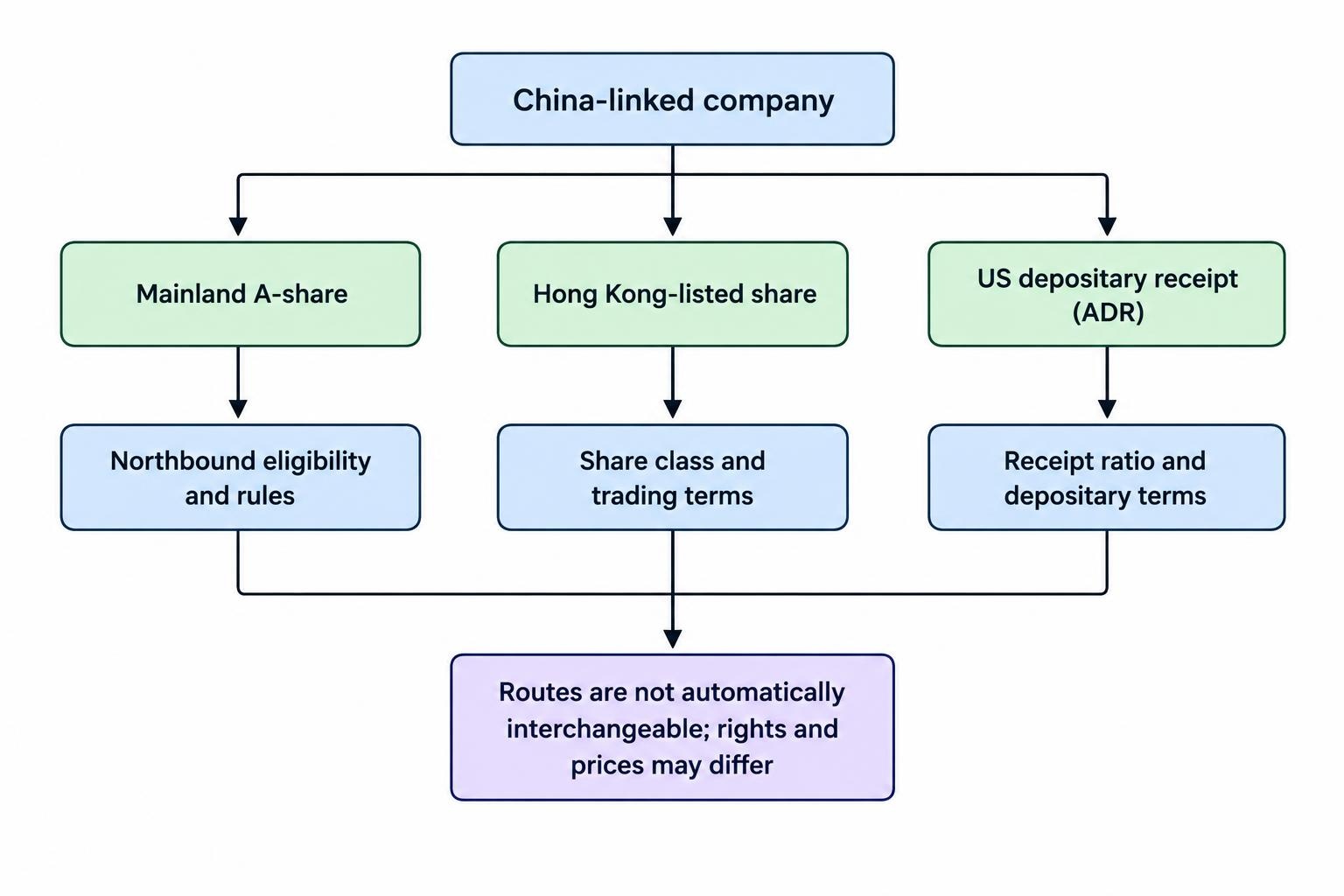
Mainland access requires more than a China market label
Northbound Stock Connect allows access to eligible mainland securities through the Hong Kong market infrastructure and participating intermediaries. HKEX’s explanation of Stock Connect describes the programme and its operation. For a broker comparison, the practical question is whether that intermediary offers the required Northbound service to the particular customer. An account with Hong Kong dealing does not automatically include mainland dealing. Nor should the investor assume that every security displayed in a search result is available to buy. Ask about eligibility, permission changes and what happens when a holding becomes available only for sale. A watchlist entry demonstrates that information is available; it does not establish that the account can acquire or transfer the security.
The trading routine must also fit the route. Northbound rules differ from those familiar to someone trading only in another market. For Shanghai Connect, the official quotation requirements and restrictions identify requirements including buy order lot sizes and restrictions on turnaround trading. The broker needs to explain the current rules applicable to the exact security, rather than the investor assume that a purchase can immediately be resold under the same conditions as a US share. Differences between boards, instruments and routes should be checked directly. These requirements affect position sizing and exits, making access quality a question of usable trading conditions rather than simply whether a mainland ticker appears on the platform.
Hong Kong shares and US receipts offer different routes
Hong Kong dealing can provide access to companies whose operating businesses are linked to mainland China, but the issuer and share class still need to be checked. A Hong Kong listing does not establish that the company has the same corporate structure or investor rights as a mainland listed business. The account also needs to support the relevant trading currency, lot arrangements and corporate actions. Where a broker provides fractional interests rather than ordinary exchange lot transactions, establish how those interests are held and whether they can be transferred. The investor should not infer direct ownership of a standard market holding from the fact that a small monetary amount can be entered into an attractive order ticket beside the company’s familiar name.
In the United States, a Chinese company’s exposure may be available through American depositary receipts, or ADRs. The SEC’s investor bulletin on ADRs explains that these instruments represent interests in foreign shares and can involve depositary charges. The receipt ratio matters when comparing prices with another listing. A dollar quote can simplify dealing in the account without removing risks related to the underlying business or its markets. Some programmes also have different trading venues, disclosure arrangements and conversion conditions. A broker offering US equities may provide a convenient access route, but the investor still needs to identify the receipt, depositary terms and fees rather than assume that a US ticker is an ordinary share in the mainland operating company.
Establish what the broker actually offers
Check the legal product and account permissions
A broker’s China coverage may include shares, funds, futures or contracts for difference. These products are not interchangeable. A CFD creates a contractual exposure to a price movement rather than the same ownership interest as holding the underlying security. It can also introduce financing charges and different counterparty arrangements. If the intention is to hold shares for several years, the account should explicitly provide the security and custody arrangement required. Search results and chart labels are insufficient because the same company can appear in several product categories. Read the order ticket, contract description and agreement together. The broker should be able to identify what will appear in the custody record after the transaction and what rights or obligations follow from that holding.
Permission also depends on the customer and the broker entity. A global brand can operate through several regulated companies with different products and account terms. The service advertised on one country’s website may not be available to a customer living elsewhere. Mainland market access, margin facilities and particular instruments can require separate approval within an account. The investor needs confirmation for the actual entity and residence rather than a general statement that the group trades Chinese shares. This article does not assume one home jurisdiction: product restrictions, reporting requirements and customer protections need checking against the relevant local framework. The location of the exchange is one part of that assessment, while the entity holding the customer relationship is another.
Compare a representative transaction
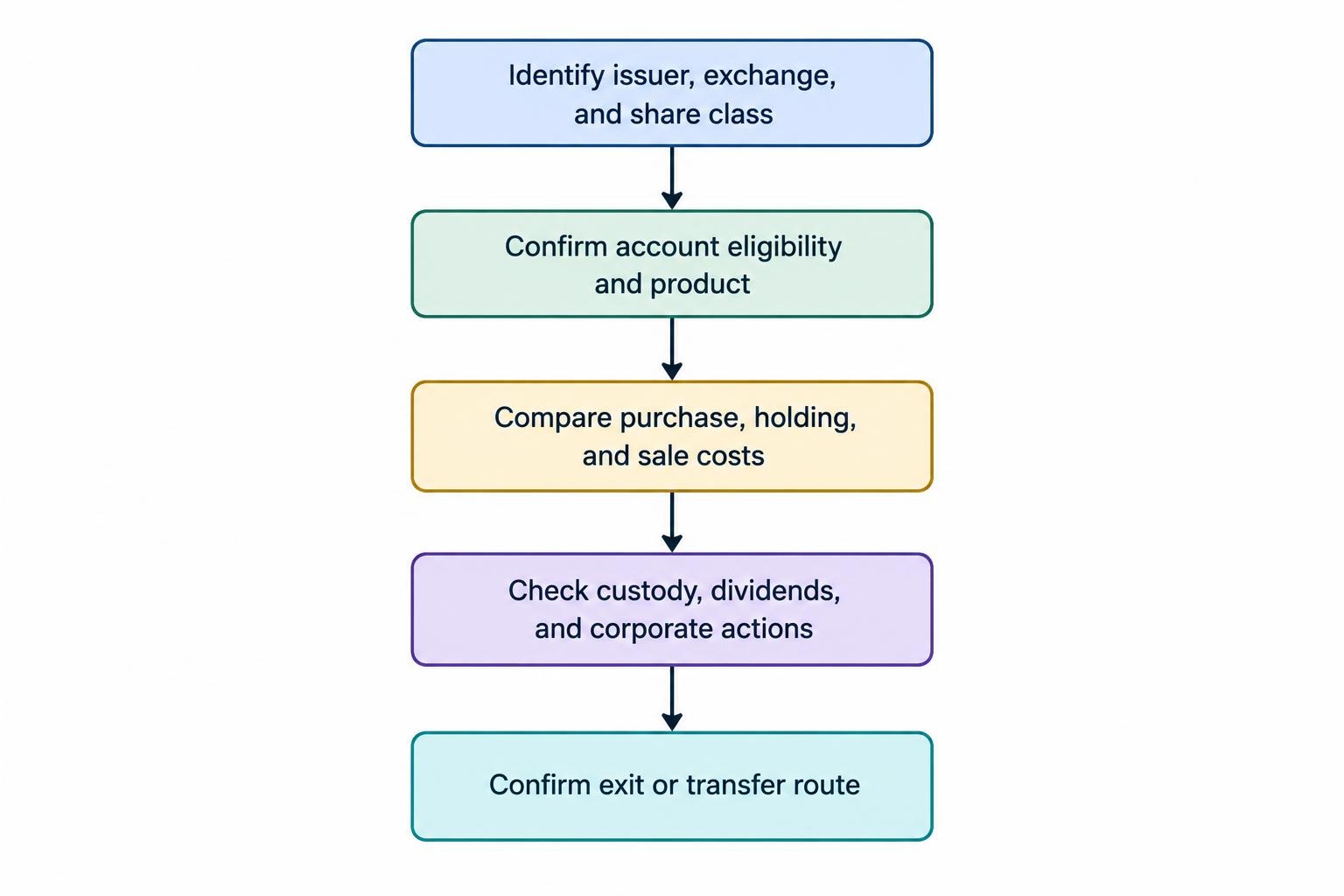
A productive comparison begins with a realistic proposed purchase, holding period and eventual exit. An investor can compare brokers with Broker Listings to identify services for further investigation, then verify the relevant details with the provider. Use the same security, quantity, account currency and expected holding period across the comparison. A broker that appears inexpensive for a large Hong Kong order may be costly for repeated small Northbound purchases, and another may not provide the required market at all. The comparison should establish that the transaction is possible before assigning weight to a low advertised commission. Its purpose is to identify an account that can carry out the intended investment process, rather than select the most appealing general description of international dealing.
Ask what happens after purchase as well as whether an opening order is accepted. The holding may generate dividends, voting invitations, rights offers or other events requiring action. It may also need to be moved to another broker later. A service that supports buying but provides poor information about those events can create substantial work during a long holding period. Written terms are more useful than an informal reassurance from a salesperson because they can be checked again when circumstances change. Record which account and service the answer concerns. The broker’s support for one share class or access route does not establish the same handling for every other Chinese security offered under the brand or displayed in its market search.
Ownership custody and company structure
Understand the chain between the account and the shares
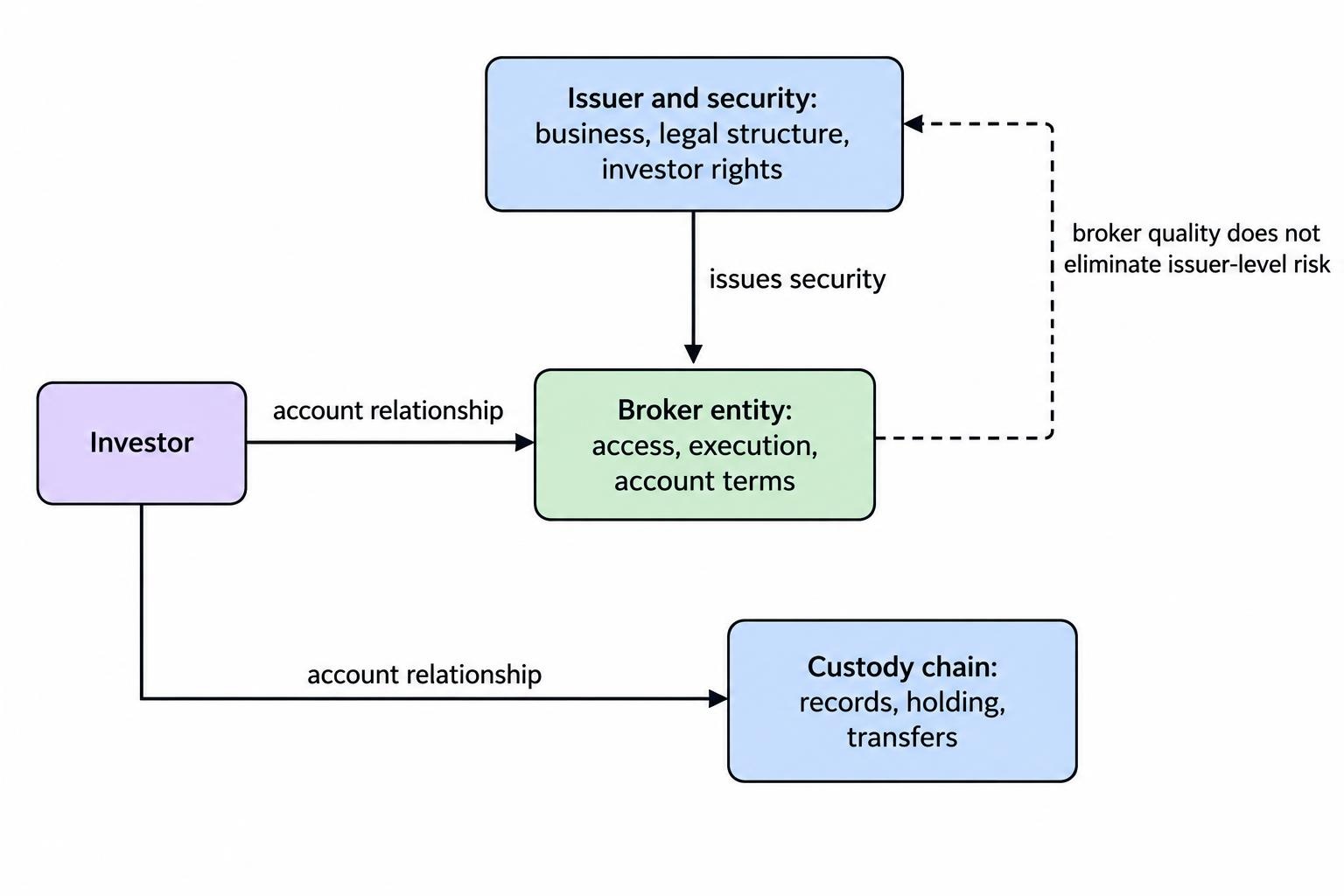
Shares are often held through nominees, custodians and market infrastructure rather than entered directly in the customer’s name on the issuer’s register. The investor needs to understand that chain without assuming that nominee holding means there is no beneficial interest. Ask who maintains the account record, how assets are identified and what procedures apply if the broker or another intermediary fails. For Northbound holdings, HKEX’s Stock Connect investor booklet describes the market infrastructure and holding arrangements. The broker must explain its own place in that structure. A general statement that assets are segregated is useful only when the relevant assets, legal entity and applicable terms are clear enough to assess.
Transfer arrangements deserve attention before the investor has a reason to leave. A broker may support trading in a security without accepting an incoming transfer or providing the outgoing route the investor expects. Receipt conversions, different custodians and market eligibility can create additional steps or charges. Do not assume that two lines associated with the same company can simply be exchanged inside the account. Request the relevant security identifiers, procedure and fee schedule. An investor planning a long holding period may reasonably accept a less convenient interface in exchange for dependable custody and transfer support. The practical value lies in preserving control of a recognised holding over time, rather than merely obtaining a low cost opening trade that later proves difficult to move.
The issuer structure is separate from the broker
Some securities linked to Chinese businesses involve an offshore holding company with contractual arrangements relating to mainland operations. That structure should not be generalised to every Chinese stock, but it matters where it is present. The US SEC investor bulletin on VIE structures explains risks where investors hold interests in a listed company that may not own equity in the Chinese operating business. This is US investor education about issuer structure, not a statement that every offshore listing uses the same arrangement. Review the company’s own filings to establish the actual position. Broker regulation and reliable custody do not eliminate a legal or economic risk embedded in the security being purchased.
The distinction helps avoid asking a broker to solve the wrong problem. A capable intermediary can provide accurate execution, statements and corporate action handling while the issuer’s business or contractual structure remains risky. Conversely, a well researched company can be held through an unsuitable account with poor access or costly administration. These are separate assessments that meet in the final investment decision. The investor should know which entity issues the security, which rights attach to it and which intermediary holds it. A company name on a portfolio screen does not answer all three questions. Good broker selection makes those relationships easier to verify; it cannot replace research into the business, its disclosures or the enforceability of the rights the investor has actually acquired.
Calculate the full cost of the account
Commission is only one part of the transaction
The complete cost can include broker commission, exchange or clearing charges, transaction levies, applicable stamp duties and currency conversion. Which amounts apply depends on the market, security and account. A headline offer of commission free dealing should therefore be read alongside the schedule of other charges. Minimum commissions can make small orders expensive even when the percentage rate looks modest. Compare the purchase and sale on the same assumptions, including whether charges are assessed per order, per execution or by another method. Current fee schedules should control the calculation. An old comparison can remain useful for identifying what to investigate without establishing the amount a particular customer will pay under the account terms available when the order is submitted.
A hypothetical example shows the effect of minimum charges. If a broker charges a minimum of HK$20 to buy and HK$20 to sell, a HK$2,000 position incurs HK$40 in those commissions alone, or 2% of the opening value. A HK$20,000 position would incur 0.2% under the same assumed minimums if no higher percentage charge applied. Neither calculation includes other costs or describes a current offer. It shows why the intended order size belongs in the comparison. Dividing a planned investment into many small purchases can increase expenses where each order triggers a minimum. A platform encouraging frequent small transactions may therefore be convenient without being inexpensive for that account’s actual fee structure and market route.
Currency conversion can exceed the visible dealing commission. If a hypothetical conversion costs 0.5% each time and the investor converts the same unchanged amount into and out of the dealing currency, the combined charge is approximately 1% before other effects. Real results also depend on the exchange rate movement, amounts converted and fee calculation. A multicurrency account may allow funds or dividends to remain in the dealing currency, avoiding repeated automatic conversions, but the provider’s terms need checking. The investor should distinguish an explicit conversion fee from a markup in the offered rate. A low stock commission is not a complete cost advantage if funding, reinvestment and withdrawal repeatedly incur expensive conversions that were omitted from the original comparison.
Ongoing charges depend on the holding and account
Custody, market data, inactivity and account administration charges can affect a longer holding period. ADR depositary fees and corporate action processing may add another layer for relevant securities. Margin borrowing introduces interest and liquidation conditions that differ from an ordinary fully paid shareholding. Calculate costs over the intended account activity rather than assess each fee in isolation. An investor making occasional purchases may obtain little value from a permanent live data subscription, while an active trader may need it. The appropriate comparison is the annual cost of a workable routine at the expected balance and turnover. A small recurring expense becomes more consequential when the account is modest or when several services charge separately for functions the investor uses infrequently.
Tax handling needs to be distinguished from the broker’s fee schedule. Source country withholding, transaction taxes and the investor’s home reporting obligations can all depend on the security and personal circumstances. A broker may supply statements without completing every calculation needed in another jurisdiction. Ask which tax documents and transaction exports are available, how distributions and currency conversions are reported and whether historical records remain accessible after closure. Avoid treating a label such as tax efficient as an answer to those questions. The value of the service is its ability to provide accurate, usable information for the relevant reporting process. Where personal tax treatment affects the choice of listing or account, that treatment needs separate verification rather than inference from the currency or location of the trading screen.
Trading functions research and account service
Match the platform to the intended routine
A platform should display the exchange, currency and share class clearly enough to distinguish similar instruments. For Chinese companies with several listings, relying only on the English name can produce the wrong order. Confirm the security identifier, quantity convention and product category before submission. The investor should also be able to inspect fees and order status without switching through ambiguous screens. A long term holder may value dependable statements and corporate action notices more than extensive charting. An active trader needs current quotations, clear execution status and controls appropriate to the market’s rules. Both benefit from exportable records. The best interface is the one that supports the intended work without hiding information that determines what is being bought or how the account will maintain it.
Orders, sessions and calendars need to be assessed for the exact route. A mainland purchase through Stock Connect does not follow every operating convention familiar from Hong Kong or US trading. The relevant programme calendar should be checked rather than inferred from the home country’s business day or an old rule about overlapping holidays. HKEX publishes Stock Connect trading and settlement calendars that support that review. The broker’s own funding and processing deadlines may also matter. A plan to buy or sell around a company event needs an account that can carry out the instruction during the required session, with cash and securities available under the actual settlement arrangements rather than merely visible on a portfolio screen.
Research should identify sources and dates
Company research needs to distinguish the legal issuer, consolidated accounts and the underlying operating business. English language summaries can be useful, but the original filing remains the reference for a financial figure or corporate action. A broker that supplies translated headlines without links to documents may leave the investor unable to verify important details. Check whether reports, exchange announcements and relevant event notices can be found and saved. The publication date matters as much as the reporting period. A figure describing an earlier year was not necessarily available to the market at an earlier decision date. Reliable research access therefore concerns traceable evidence rather than the number of articles displayed beside a stock or the strength of a platform’s automated sentiment score.
Support quality becomes visible when the question concerns an event or account constraint rather than a password reset. Ask how the broker handles a rights offer, an approaching election deadline or a security whose purchase eligibility changes. The response should identify the relevant account and document, not repeat a general description of international access. Language and service hours also affect usefulness when the market is open at a different time from the customer’s location. A low commission may be less valuable if an account problem cannot be investigated until after a deadline. The comparison should include ordinary communication and escalation routes, with realistic expectations about what the provider can resolve and which issues depend on custodians, issuers or the market infrastructure.
Regulation protections and a practical decision
Verify the entity rather than the brand alone
The broker’s regulatory position should be checked independently using the entity named in the account agreement. For a Hong Kong intermediary, the SFC public register is a relevant source for checking licensed corporations and registered institutions. The activities and conditions recorded matter alongside the name. A global brand’s licence in one jurisdiction does not establish that the customer account is held by that company or receives the same protections. Match the official contact details and investigate discrepancies before transferring money. This is a Hong Kong verification route; customers dealing with an entity elsewhere need that jurisdiction’s regulator and records. The exchange on which a share trades does not independently verify the business receiving the customer’s deposit.
Account protections also need precise scope. Client asset arrangements and compensation schemes are intended to address defined failures under specified rules; they do not insure ordinary market losses or guarantee a company’s share price. Coverage can depend on the entity, product, claim and investor category. Ask which framework applies to the proposed account and where its terms can be checked independently. A large number displayed beside a protection claim is not enough without that context. The same caution applies to uninvested cash, which may be treated differently from securities or placed through another arrangement. The investor should understand the holding and the relevant claim process before relying on a general statement that the account is protected or that the provider is part of a well known financial group.
Test the proposed arrangement before scaling it
Once eligibility and the business have been established, a practical trial can assess the routine. Use official applications and a supported demonstration environment where available to practise identifying the security, entering a quantity and checking the resulting record. If a funded trial is appropriate, keep it within the intended risk budget and inspect the actual statement, conversion and charges. A successful small withdrawal confirms that particular payment occurred, not the future safety of every balance. The purpose of the trial is narrower: to identify errors, unexpected expenses and operating limits before the arrangement becomes larger or more difficult to change. Keep evidence of the terms assessed so that later changes to the service can be distinguished from assumptions made during the comparison.
The final choice should fit the security, holding period and customer circumstances together. An investor wanting a specific mainland share needs verified access and suitable Northbound handling. Someone choosing a Hong Kong listing needs its custody, currency and corporate action arrangements. A US receipt requires attention to the depositary structure and relevant fees. Across those routes, reliable ownership records, usable exports and a clear transfer process can matter as much as the opening commission. Comparing brokers becomes a practical task when the investor can describe the exact holding and every step from funding to eventual exit. The appropriate account is the one that supports that process on intelligible terms, with risks and costs that remain visible after the initial purchase has been completed.